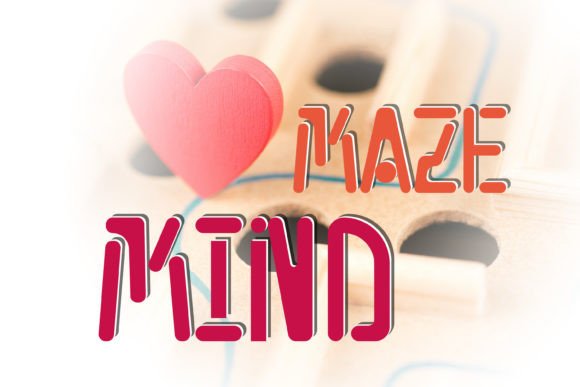
Maze Mind: A Whimsical Display Font for Handmade Creators
As a maker who designs printable wall art, hand-stamped tags, and custom wedding invitations, I’m always hunting for display fonts that do more than just look pretty—they need to work. Maze Mind is one of those rare typefaces that balances charm with clarity, quirks with commercial practicality. It’s not overly ornate, not too childish, and never forgettable. It’s got personality—playful curves, gentle asymmetry, and just enough bounce to feel alive on paper, vinyl, or fabric.
Maze Mind lives firmly in the display font category, which means it shines brightest where impact matters most: headlines, product names, signage, and short bursts of text. Think “Small Batch Candle Co.” stamped on a kraft label, “Welcome Home” laser-cut into farmhouse wood, or “Happy Birthday!” dancing across a printable party banner. Its whimsical energy makes it ideal for brands and products that want warmth, approachability, and a touch of handmade soul—without sacrificing legibility at real-world sizes.
Where Maze Mind Fits Into Your Physical Product Workflow
You’ll reach for Maze Mind when you need a font that feels intentional—not decorative filler. On candle jars and soap labels, its rounded forms soften sharp edges and invite touch. Printed at 14–18pt on matte sticker stock, it holds crispness even after die-cutting. For Cricut and Silhouette users, Maze Mind cuts cleanly on medium-weight cardstock and vinyl; avoid scaling below 10pt for intricate interior counters (like the center of “e” or “a”), but otherwise, it’s reliably production-friendly.
It’s especially effective on seasonal and boutique packaging: imagine “Pumpkin Spice Latte Mix” in Maze Mind on a burlap bag tag, or “Hand-Poured Soy Wax” arcing over a minimalist jar label. The font’s subtle irregularity adds artisanal authenticity—customers subconsciously register it as *made*, not mass-produced. That perception lifts perceived value, especially in markets like Etsy, local craft fairs, and indie retail shelves.
Real Projects That Sing With Maze Mind
- Wedding stationery: Use Maze Mind for “Mr. & Mrs.” on foil-pressed welcome signs or “RSVP by June 15” on RSVP cards—paired with a soft serif like Playfair Display for balance.
- Digital printables: It anchors planner covers, habit trackers, and quote-based wall art—especially when layered over muted watercolor textures or linen backgrounds.
- SVG designs for merchandise: Maze Mind scales beautifully on mugs, tote bags, and T-shirts. Its open letterforms hold ink well during screen printing and DTG, and the rhythm of its baseline keeps phrases visually cohesive—even when curved along a mug handle.
- Sticker sheets and enamel pin mockups: Its friendly proportions read clearly at 3/4” height, making it perfect for mini “Yay!” or “Hello, Sunshine!” stickers sold in themed bundles.
- Farmhouse and cottagecore signs: Carve or paint “Gather Here” or “Bake Often” in Maze Mind—it leans into rustic charm without veering into cliché.
Pairing Maze Mind Thoughtfully
Maze Mind thrives when paired with contrast—not competition. Because it’s expressive, it needs grounding. Try it with a clean, neutral sans serif like Montserrat or Inter for ingredient lists, care instructions, or small-print disclaimers. For elegant stationery, pair it with a delicate script (think Pacifico or Quicksand) for names or monograms—but keep the script secondary. Avoid stacking two high-contrast display fonts; Maze Mind already carries visual weight.
If your project includes multilingual support (e.g., bilingual baby shower invites or international product labels), verify Maze Mind includes extended Latin characters—standard accented letters like é, ñ, ü are essential for real-world usability. Most quality display fonts include these, but always check before finalizing templates or SVG exports.
What to Expect From the Maze Mind Files
You’ll typically receive Maze Mind in OTF and TTF formats—both fully compatible with Canva, Adobe Creative Cloud, Cricut Design Space, and Silhouette Studio. If ligatures or stylistic alternates are included (like a swash “Q” or connected “Th”), they’re bonus tools—not requirements—for refining your design polish. Don’t feel pressured to use them everywhere; sometimes the default character set has all the charm you need.
Licensing That Supports Your Business
This matters: Maze Mind is a commercial font, and its license covers physical product sales, digital downloads (like Canva templates or printable planners), SVG files for cutting machines, and client work—no extra fees or attribution required. You’re free to use it on merchandise you sell, in shop banners, and even embedded in PDFs you deliver to customers. Just confirm your purchase includes an extended commercial license (most reputable font shops do), and you’re covered from Etsy listings to wholesale catalogs.
One last note: Maze Mind isn’t built for body text. Don’t try to set a full invitation paragraph or product description in it. Save it for titles, names, slogans, and focal words—the places where your customer’s eye lands first. That restraint is what makes it powerful. When used with intention, Maze Mind doesn’t just decorate your work—it reinforces your brand voice, strengthens emotional connection, and quietly tells your audience: *this was made with care*.